

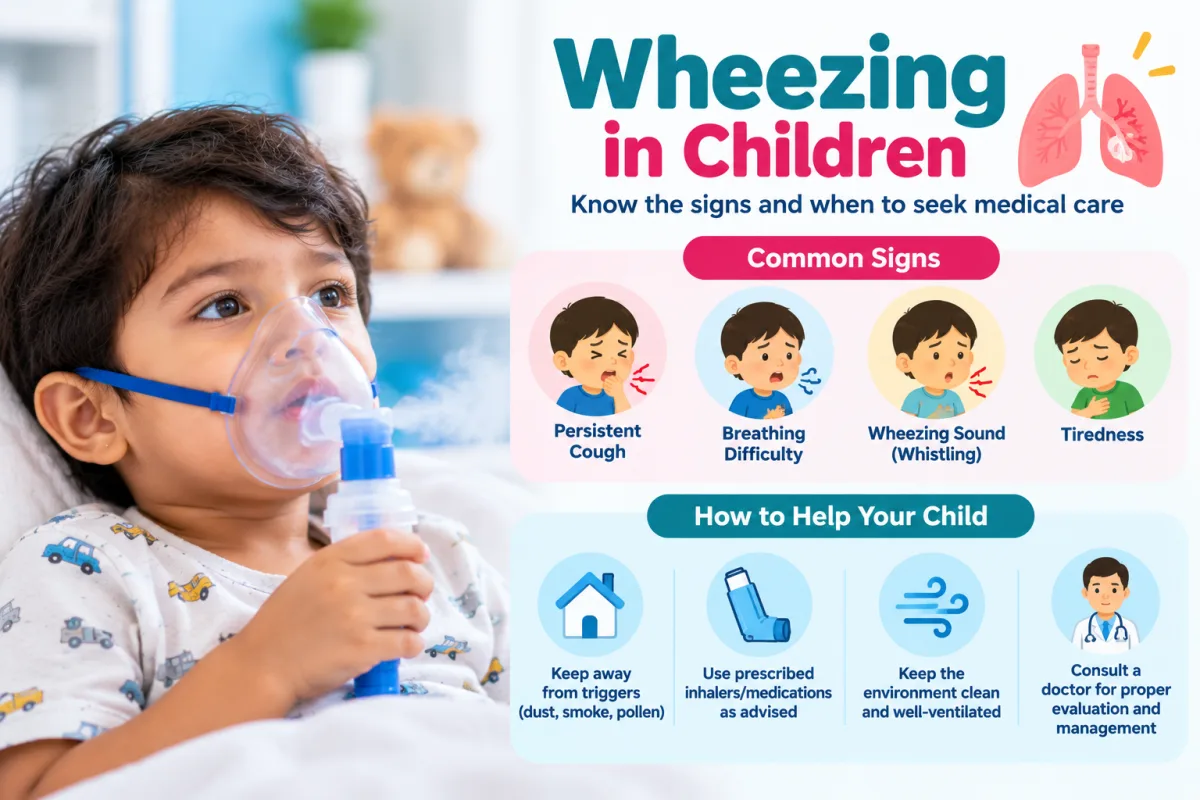
In short: Wheezing — a whistling sound when breathing out — is common in young children, especially with colds. Not every child who wheezes has asthma. Repeated wheezing, night-time cough, or wheezing with exercise, dust or pets suggests asthma. Go to emergency if your child is struggling to breathe, can’t speak or feed, or has blue lips.
What is wheezing?
Wheezing is a high-pitched whistling sound, usually when breathing out, caused by narrowed airways. Parents sometimes describe it as a “whistle” or “rattle” in the chest. A rattly noise from a blocked nose is different — that comes from the throat and nose, not the lungs.
Common reasons children wheeze
- Viral infections: in children under 3, colds often cause wheezing because their airways are small. Many outgrow this by school age.
- Bronchiolitis: a viral chest infection in babies under 2, often in the cooler months, causing cough, fast breathing and wheeze.
- Asthma: long-term airway sensitivity with repeated episodes of wheeze, cough and breathlessness.
- Less common causes: an inhaled object (sudden cough or wheeze while eating or playing), reflux, or allergies.
Viral wheeze or asthma?
| Feature | Viral wheeze | Asthma |
|---|---|---|
| Usual age | Under 3–5 years | Any age, more often after 3 |
| When it happens | Only with colds | With colds and also with exercise, dust, smoke, pets or weather change |
| Between episodes | Completely well | Night cough or breathlessness may continue |
| Family history | Often none | Often eczema, allergies or asthma in the family |
| Outlook | Many outgrow it by school age | Well controlled with a preventer and an action plan |
Signs that point towards asthma
- Wheezing or coughing again and again, not only with colds
- Night-time or early-morning cough
- Wheeze or breathlessness with running, laughing or crying
- Triggers like dust, smoke, pets, pollen or weather changes
- A personal or family history of eczema, allergic rhinitis or asthma
There’s no single test for asthma in young children. Your pediatrician makes the diagnosis from the pattern of symptoms, examination and response to treatment. Older children may do a breathing test (spirometry).
How asthma is treated
- Reliever inhaler: opens the airways quickly during symptoms.
- Preventer inhaler: a low daily dose that calms airway sensitivity, for children with frequent symptoms.
- Spacer: a tube attached to the inhaler (with a mask for young children) so the medicine reaches the lungs. Inhalers with spacers work as well as nebulisers for most children.
- Avoiding triggers: no smoking at home or in the car, reducing dust, and managing allergies.
- A written asthma action plan for home and school.
Inhaled medicines use tiny doses that go straight to the lungs, so side effects are much lower than with syrups or tablets.
Go to emergency immediately if your child:
- is struggling to breathe, with the skin pulling in between the ribs or below the neck
- can’t speak in full sentences, or a baby can’t feed
- has blue or grey lips
- is very drowsy or the reliever inhaler isn’t helping
When to book a visit
See a pediatrician if your child has had more than one episode of wheezing, a cough lasting more than 3 weeks, or a night cough that keeps coming back. Learn more about our pediatric consultations or book an appointment.